
Guide bushing offset calculator
Enter your bushing and bit and see how far the template edge sits from the cut, for a pocket and for an inlay piece.
Hole: (OD − bit) / 2 + clearance · piece: (OD + bit) / 2 + clearance
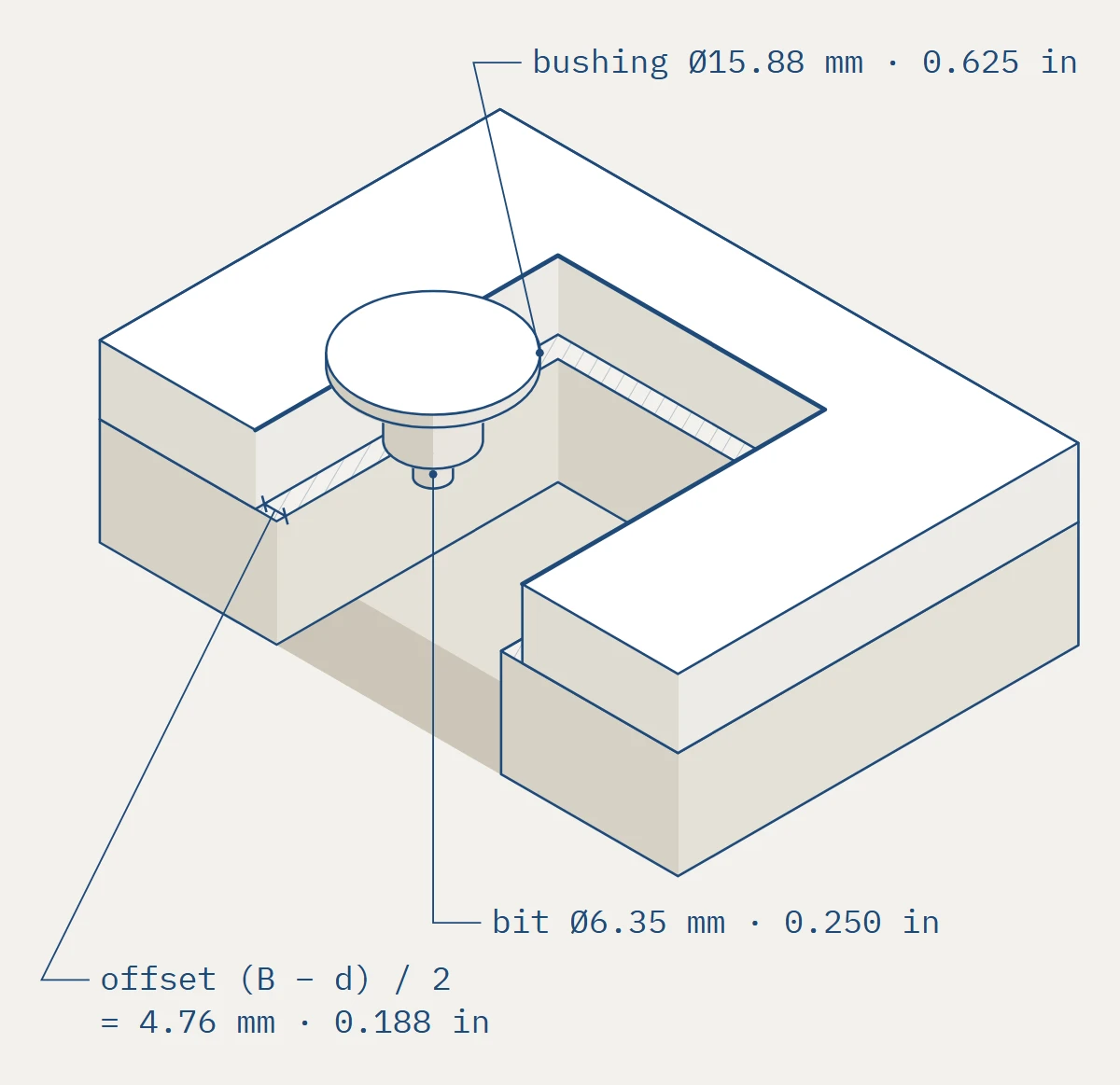
Hole mode and piece mode
A guide bushing rides against the template while the bit cuts a little away from it. The distance between the template edge and the cut is the offset, and it depends on whether you are routing a pocket or cutting a piece.
Hole mode is for a pocket or a mortise. The bushing runs on the inside edge of the template opening, so the offset per side is (bushing outside diameter − bit diameter) / 2, plus clearance. Piece mode is for cutting an inlay piece from outside. The offset is (bushing outside diameter + bit diameter) / 2, plus clearance.
In hole mode the bit has to be smaller than the bushing, or it would not fit inside it. The calculator says so instead of giving a number.
Work out your offset
Pick a bushing, or choose Custom size and type its outside diameter. Type the bit diameter as a decimal or an inch fraction, such as 1/4, 5/16 or 1-1/4. The result updates as you type.
Clearance is the small gap that lets the piece drop into the pocket. It defaults to 0.25 mm per side (about 0.01 in) and you can change it. Test a template on scrap wood before you cut the board.
A worked example
Take a Porter-Cable 42033 bushing, which is 1/2 in (12.7 mm) outside, and a 1/4 in (6.35 mm) bit. In hole mode, (1/2 in − 1/4 in) / 2 is 1/8 in, or 3.175 mm. Add the 0.25 mm clearance and the offset is 3.425 mm (0.135 in) per side.
A 100 mm pocket then needs a template hole that is 100 mm plus two offsets, which is 106.85 mm. In piece mode the same bushing and bit give (12.7 + 6.35) / 2 + 0.25, which is 9.775 mm per side.
To turn the numbers into a template, open the generator, pick the bushing and the bit, and choose a shape. The bowtie inlay template is a good first one.
Measure the bushing outside diameter
The offset depends on the real outside diameter of the bushing, so measure yours with calipers instead of trusting the label.
- Close the caliper jaws and check that they read zero.
- Clamp the jaws on the outside of the bushing barrel, the part that rides against the template, not on the flange or the spigot.
- Take the reading at two or three spots around the barrel and use the largest.
- Choose Custom size in the calculator and type that number in millimeters or inches.
Questions about guide bushing offset calculator
What is the offset for a 1/2 in bushing and a 1/4 in bit?
In hole mode it is 3.425 mm (0.135 in) per side: 1/8 in (3.175 mm) from the size difference plus the default 0.25 mm clearance. In piece mode it is 9.775 mm per side.
When do I use hole mode and when piece mode?
Use hole mode for a pocket or a mortise, where the bushing runs inside a template opening. Use piece mode to cut an inlay piece from outside.
What clearance should I use?
The default is 0.25 mm per side (about 0.01 in), and you can change it. Cut a test piece in scrap wood and adjust the clearance if the fit is too tight or too loose.
Why does the calculator say the bit must be smaller than the bushing?
In hole mode the bit passes through the bushing, so a bit equal to or larger than the bushing outside diameter cannot work. Pick a smaller bit or a larger bushing.
Does it take millimeters and inches?
Yes. Switch the units at the top, and type decimals or inch fractions such as 1/2 or 1-1/4. Clearance is always in millimeters.